The Processing Season Has Started
Egypt's pomegranate campaign is under way. The early fruit began coming in around late July, the main August intake is running now, and the season builds through September and October before closing in November.
For a processor the relevant point is not which varieties are on the tree but that the intake window is open and closes in November. Processing volume is committed during a campaign, not after it — and Egypt's is running now.
One structural detail is worth knowing: part of the Egyptian crop is grown for the processing trade rather than diverted to it from the fresh market. That is unusual. In most fruit categories the processor takes what the fresh trade rejects — the undersized, the blemished, the surplus — and it shows up in the consistency of what arrives at the plant.
A Stable Crop in an Unstable Region
Egyptian pomegranate production stands at approximately 800,000 tonnes annually and has not moved much this season — new planted areas compensate for ageing trees, which makes the stability structural rather than a lucky year. Several neighbouring North African producers have had a harder time with climate this season; Egypt was largely spared the extreme heat that affected them.
The genuine pressure on the Egyptian side is logistics. Farm-gate prices are stable, but rising exporter costs and regional conditions pushing up transport are squeezing margins — and freight, not fruit, is the factor most likely to move a delivered price this season.
| Stage | Timing | What It Means for Processing | |
|---|---|---|---|
| 🍎 | Early intake | From late July | Season opens ~20 days ahead of the main crop |
| 🍎 | Main intake — running now | August | Processing-destined fruit at its most available |
| 🍎 | Peak | September–October | Largest volume; prices differentiate as supply builds |
| 🍎 | Season close | November | Raw material committed by this point |
| ❄️ | Frozen arils | Year-round | Decoupled from the harvest window |
Why This Crop Suits Juice and Concentrate
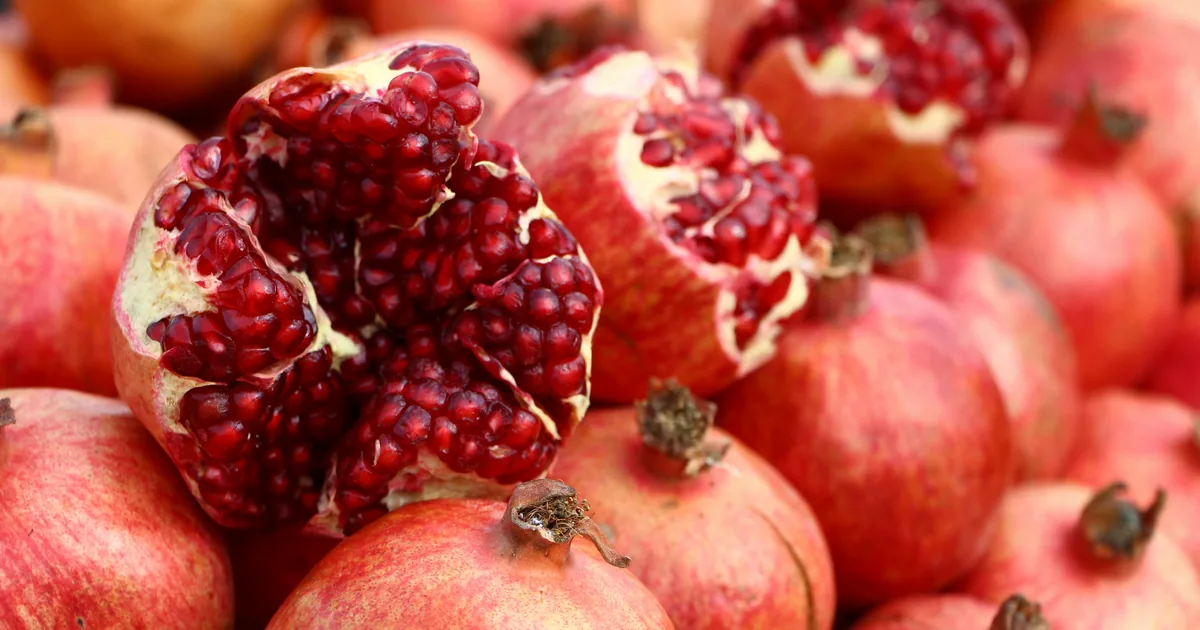
Juice content and colour are the two things that matter. The attributes Egyptian pomegranate is exported on — deep red colour, high juice content, a sweet-tart balance — read differently on a processing line than in a retail display. Juice content is yield per tonne. The acid-sugar balance determines whether a juice needs correcting. And colour is the first thing a consumer judges a pomegranate juice on, long before taste.
Supply is stable when several alternatives are not. For a juice or concentrate programme, the question is less about fruit characteristics — which are broadly known — than about whether the tonnage will be there. An origin holding output on expanding planted area answers that differently from one recovering from a weather event.
Frozen arils run year-round, which decouples aril supply from the harvest window for anyone building a continuous programme rather than a seasonal one.
Where Egyptian Pomegranate Sells Today
Egyptian pomegranates reach 52 international markets, with export value up significantly in 2025. The concentration, however, is striking — for January to September 2025:
- UAE — €34 million, roughly half of all pomegranate export value
- Syria — €21 million
- Russia — €3.5 million
Export prices run €615 to €1,100 per tonne FOB depending on specification, expected to hold firm early and differentiate as supply builds, with the early crop benefiting from limited supply and an early market position. The Netherlands and France are named as under-exploited European opportunities, and China access has recently been obtained. Competition comes from Iran, India and Oman, with Egyptian exporters noting that the regional conditions raising transport costs apply to everyone, Egypt included.
What It Means for Processed Pomegranate Buyers
The window is open now. The main intake is running this month and the season closes in November — a juice or concentrate programme for 2027 is being decided in the next few weeks.
Price the logistics separately from the fruit. Farm-gate prices are stable; the movement is in freight and exporter costs. A quote not broken into fruit and transport is harder to compare against last year's, and harder to renegotiate if freight eases.
Egypt's fresh trade is Gulf-weighted. With roughly half of export value going to the UAE and a large share to Syria, European processing demand competes for Egyptian fruit against a fresh trade pointed mostly elsewhere — a more comfortable position than competing head-on with a dominant fresh outlet.
🍎 Key Takeaway for Pomegranate Buyers
Egypt's pomegranate processing season has just opened and closes in November. Production is stable at around 800,000 tonnes on expanding planted area, at a time when several regional origins have had a difficult year, and the real cost variable is freight rather than fruit. If you buy pomegranate juice, concentrate or arils, this is the month to be having the conversation.
Saporina's Pomegranate Range
Saporina supplies Egyptian pomegranate as juice, concentrate and nectar — in aseptic bulk bag-in-drum for industrial buyers, and in glass, PET and carton for retail and HORECA, including private-label formats, with full export documentation for EU, UK, North American and Gulf destinations. The same fruit programme also covers our mango, guava and strawberry lines.
📩 The Season Is Running — Talk to Us Now
Contact Saporina to discuss pomegranate juice, concentrate and nectar from the 2026 Egyptian crop — aseptic bulk, retail and private-label formats. Specifications, Brix and acidity ranges, and samples available on request.