The Season Opens in the Field
Across Egypt's Delta growing regions, the 2026 white bean summer season is in motion. Threshing machines are working the first fields, freshly harvested beans are being cleaned and sieved at the farm gate, and collection centers opened for intake shortly after the Eid al-Fitr holiday — the traditional starting gun for the season's trade.
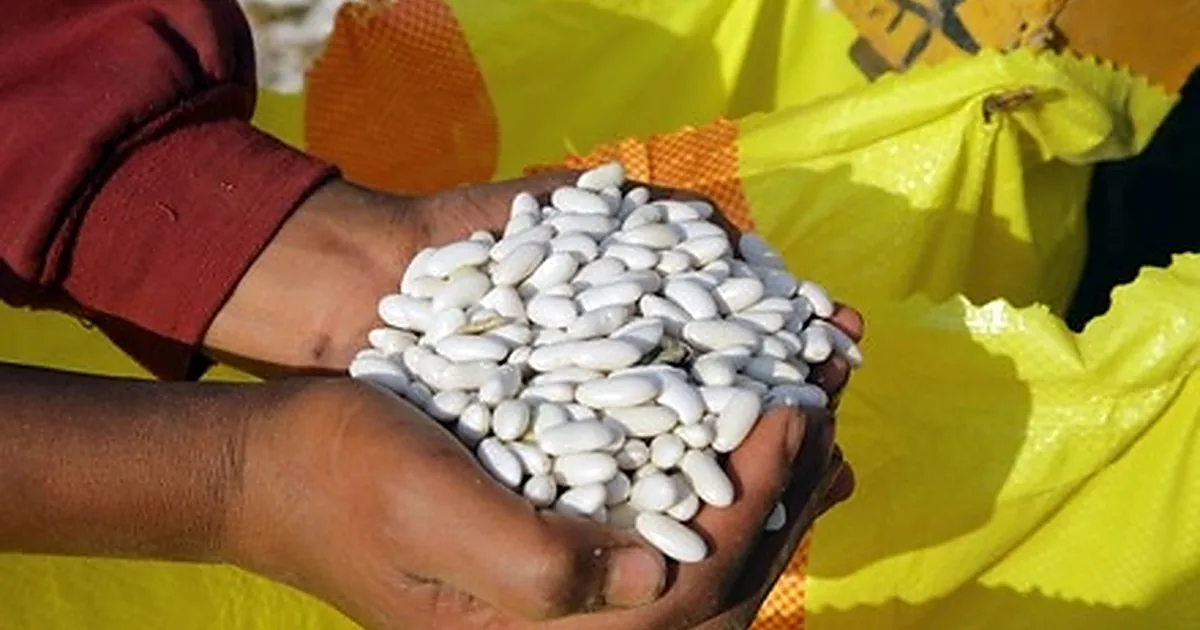
Early-season field impressions suggested healthy, well-colored beans coming off the first plots, with intake infrastructure running and quality sorting happening from the first day in the field.
🫘 Season Update — September 2026
The summer crop is in. Egyptian bean exports — fresh and dried — passed 110,000 tonnes in the first half of 2026, keeping beans among Egypt's leading agricultural export lines within total agricultural exports of more than 5 million tonnes over the same period. The Ministry of Agriculture and Land Reclamation attributes the performance to expanded export production areas and to crop coding and phytosanitary control systems — the same compliance machinery discussed below — alongside 21 new export markets opened during the half-year. With the crop harvested, dried and threshed, this is the window in which dried bean volume is contracted.
What Happens Between the Field and the Can
The consistency Egyptian white beans are bought on is produced in a fairly narrow set of field decisions, and it is worth understanding what they are — because they are also where quality is lost.
In Dakahlia (الدقهلية), one of the Delta's established growing areas, the crop runs roughly 85 to 100 days from planting to harvest. Growers begin when the leaves turn yellow and the pods go light brown. Plants are pulled from the root — by hand or machine — and left to sun-dry for about 15 days before threshing separates the beans from the plant material. Yields average 1 to 1.3 tonnes per feddan, varying with soil type and the care given to the crop, against production costs of around EGP 30,000 per feddan covering seed, planting, irrigation, fertilisation, cleaning, harvesting and threshing.
Growers name two risks specifically, and both are quality risks rather than yield risks: harvesting before full maturity, and cutting the drying period short. Either one reduces grain quality and market value. For a canner that is the whole story in one sentence — maturity and moisture at harvest are what determine whether a bean holds its shape and colour through thermal processing, or arrives split and soft in the can. The 15 days on the ground are not idle time; they are the specification being met.
The pressure on that discipline is economic. Rising input and labour costs have increased the financial burden on growers, who are looking for price stability to offset them. A buyer paying on price alone, from any origin, is ultimately paying for the shortcuts that price forces.
Meanwhile, the EU Raises the Bar
The new season is opening against a significant regulatory backdrop. The European Union is tightening its inspection regime for imported agri-food products: audit rates for non-EU suppliers are reported to be rising from 33% in 2025 to a projected 51% by 2026, with particular scrutiny on pesticide residue levels (MRLs) and traceability documentation.
For white bean exporters worldwide, this is not a distant policy debate — it is already reshaping how origins operate, invest, and compete for EU market share. Origins that treat compliance as an afterthought will find the EU market progressively harder to serve. Origins with established compliance systems stand to consolidate their position.
Why the Sourcing Math Favors Egypt
Egypt enters this tighter regime from a position of structural strength — built on four advantages that are difficult for competing origins to replicate:
There is also a reputational shift underway. Egyptian white beans have built a track record for superior quality and consistent color, season after season — and that consistency, more than anything else, is what has driven Egypt's rise to the top of the global white bean exporter rankings. Reliability is becoming Egypt's calling card in the EU market.
Pressure on the Southern Hemisphere Alternative
The world's other major white bean origin enters 2026 EU-compliant but under visible supply pressure, according to industry reporting: excessive rainfall is said to have delayed planting by ten to twenty days, production costs are described as the highest in a decade, and planting area is estimated to be down 10–15% as farmers shift toward corn and soy. Several unstable crop cycles had already pushed EU buyers to diversify — with Egypt the principal beneficiary.
None of this makes that origin uncompetitive. But the direction of travel is clear: one origin is expanding capacity and consistency while the other manages weather, cost, and acreage headwinds.
What This Means for Buyers
Compliance is becoming the entry ticket — verify it. With audit rates rising toward 51%, the cost of a rejected consignment grows. Buyers should weight supplier selection toward origins and partners with documented MRL programs and full traceability, not just attractive offers.
Proximity is a working-capital lever. A 2–7 day transit from Egypt versus 4–6 weeks from South America means EU buyers can run leaner inventories and respond to demand swings — a quiet but real cost advantage that compounds over a contract year.
The dual harvest de-risks the calendar. Egypt's summer and winter crops mean two intake windows per year. Buyers can stagger contracts across both rather than betting a full program on a single hemisphere's weather.
The contracting window is now. With the summer crop harvested, dried and threshed, dried bean volume is committed in the weeks after harvest rather than during it. Egypt's winter crop provides the second intake window later in the season.
🫘 Key Takeaway
Egypt's 2026 white bean summer crop opened on schedule and is now in, with bean exports past 110,000 tonnes in the first half of the year. With EU inspection rates climbing toward 51% and the main competing origin facing weather delays and an estimated 10–15% acreage decline, the structural case for Egyptian white beans — compliance, 2–7 day transit, dual harvests, and consistent quality — remains strong. With the crop dried and threshed, this is the contracting window.
Saporina's White Bean Program
Saporina's white beans come from Egypt's established growing regions, drawing on both the summer and winter crop intake. They ship with full traceability and export documentation aligned to EU and other destination-market requirements — canned in brine or tomato sauce, and available in retail, HORECA, and industrial formats with private label capability.
With the summer crop harvested and the winter intake ahead, this is the right moment to scope 2026/27 white bean programs — volumes, formats, and shipment schedules across both harvest windows.
📩 Plan Your 2026/27 White Bean Program
Contact Saporina to discuss white bean availability from the new summer crop — formats, specifications, documentation, and shipment schedules. Both harvest windows can be contracted now.