🥭 Update — 1 October 2026: Peru's Mango Crop at Risk from El Niño
Peru, the main supplier of mango in the Northern Hemisphere winter, is heading into a difficult 2026/27 campaign. A mango-sector specialist presenting the season's monitoring analysis projects a national production fall of about 60% against last year, with El Niño as the main driver: Peru's official El Niño committee (ENFEN) puts the probability of a global El Niño at 100% and of a coastal El Niño at 62%.
The risk is concentrated in the north. About a third of Piura's crop is due to be harvested between late December and mid-January — the weeks of highest rainfall risk — and light November rains could affect up to 30% of the fruit through anthracnose. Weak flowering, flooded river valleys and damaged roads add pressure on both harvest and logistics. Casma, further south, faces lower direct rainfall risk. The 60% figure is a projection, and the outcome will depend on how the rains develop.
This is an unwelcome season for Peru's growers, who face a weather loss they did not choose.
What it means for buyers: Peru's harvest fills the months when Egypt's season has closed. Buyers who normally cover winter needs for mango purée, frozen or canned mango from Peru should review that cover now. Egypt's large 2026 crop ran from late June into November, so purée and canned mango packed this season can bridge part of the gap. For the wider picture, see our El Niño 2026/27 crop exposure report.
The 2026 Egyptian Crop
Egypt is heading into an abundant mango year. The season forecast reported in June put the harvest at 1.6 million tonnes, against 1.4 million tonnes last season — with early picking already under way in Upper Egypt, in Aswan (أسوان) and Minya (المنيا), and the main export regions of Ismailia (الإسماعيلية) and the reclaimed desert areas following.
A separate July report describes Egypt's standing mango production at around 2 million tonnes annually from over 100,000 hectares. The two figures are measured on different bases — one a season forecast, the other an annual production capacity — and both are worth carrying, because together they describe an origin with real depth rather than a marginal one.
The season structure is what makes it commercially useful. Harvest opens in late June with the early Upper Egypt varieties and runs through to November on late-maturing types, with peak shipment volume across July, August and September. That is a long window by mango standards, and it is a processing window as much as a fresh one.
| Period | Varieties | Note | |
|---|---|---|---|
| 🥭 | Early — from late June | Toumi (التيمور), Mabrouka (المبروكة), Owais (العويس), Hindi (الهندي) | Upper Egypt opens the season |
| 🥭 | Main — from mid-July | Keitt, Crimson, Naomi, Kent | Keitt was the most exported variety last season |
| 🥭 | Traditional Egyptian types | Baladi (البلدي), Zebda (الزبدية), Seddiqa (الصديقة) | Aswan and Upper Egypt local varieties |
| 🥭 | Late — through November | Keitt, Kent, Austin, Osteen, Palmer, Tommy Atkins, E2R2 | Extends the season well past most origins |
The Global Backdrop: A Tight Market
The wider mango market has been constrained this year, and the reason is weather rather than demand. Cooler spring conditions hurt flowering and slowed development in key Mexican regions, while later heat shifted maturity timing. Shipments from Mexico, Guatemala and the Dominican Republic were projected to run well below last year from late June into early July, with Mexican volumes described as sharply reduced against normal seasonal expectations.
The market commentary is unusually candid about what that has done: "Mango supply is very tight, and a lot of the fruit is being diverted to the fresh market," leaving less product available for other channels. And "demand isn't super high but there isn't much to go around" — a firm market driven by scarcity rather than enthusiasm.
That first quote is the one processors should read twice. When fresh markets tighten, fruit gets pulled toward fresh, and processing is the channel that goes short. Purée, concentrate, nectar and canning compete for raw material against a fresh trade that can usually outbid them in a scarce year — which is precisely when processed mango contracts become difficult to fill and prices firm up regardless of finished-goods demand.
None of this is good news for growers in Mexico, Guatemala or the Dominican Republic, who are carrying a weather loss they did not choose. But it does explain why an abundant, long-season origin matters to a processed buyer this year in a way it might not in a comfortable one.
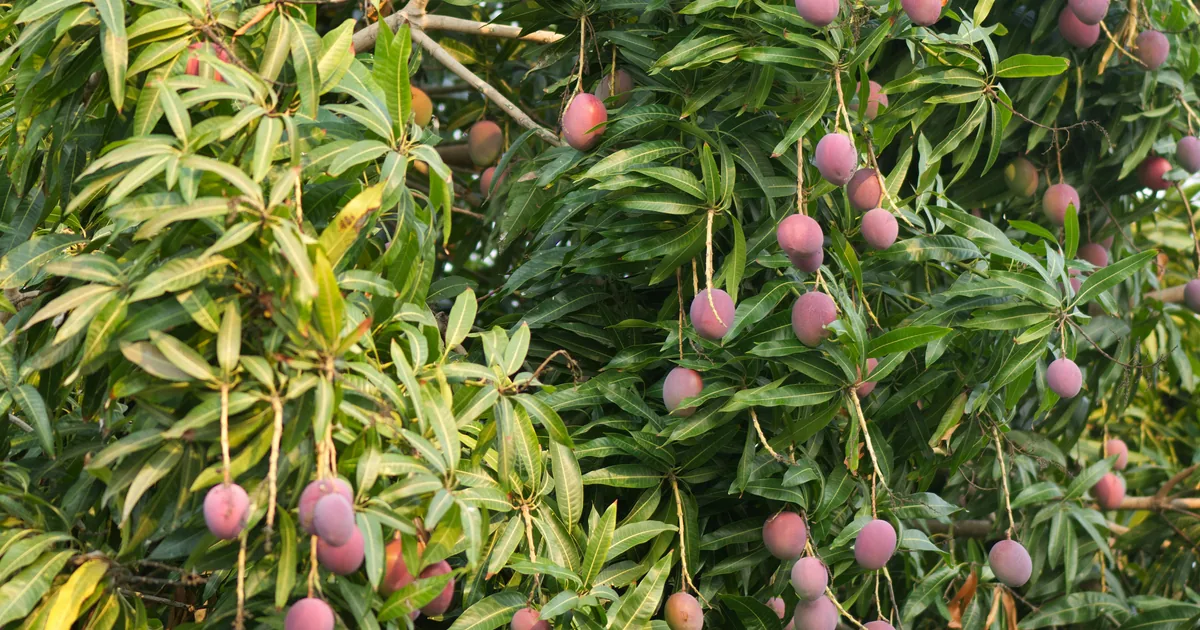
Why Egyptian Mango Suits Processing
Three characteristics reported consistently across this season's coverage matter more to a processor than to a fresh importer.
High Brix. Egyptian mangoes are described as a high-Brix, naturally sweet, low-fibre fruit — attributes that fresh buyers value for eating quality and that processors value for a different reason entirely: soluble solids are yield. A higher incoming Brix means more concentrate per tonne of fruit and less added sugar in a nectar formulation.
Low fibre. Fibre content is a purée quality problem, not just a mouthfeel one. Low-fibre fruit gives cleaner pulp, easier screening and better finished texture in purées and nectars.
A variety mix built for a long run. Keitt, Kent, Naomi and Crimson through the main season, with late types extending to November, gives a processing plant a genuinely long campaign on a consistent raw material rather than a three-week scramble.
The certification picture is also established rather than emerging. Egyptian mango exporters supplying European and British retail hold GlobalG.A.P., GRASP, SMETA and, in at least one case, BRCGS — the same schemes a processed-goods buyer would expect to see behind a purée or nectar programme.
Where Egyptian Mango Already Sells
Egyptian mango exports set a record in 2025 at approximately 117,000 tonnes, growth Egyptian authorities attribute to opening new markets and to strict quarantine and quality controls on outbound shipments. Fruit-fly control in particular is described by exporters as a rigorous, professionally managed programme — which matters, because fruit fly is the single issue most likely to close a mango market.
The destination map has broadened well beyond the traditional base:
- Established: the GCC — Saudi Arabia, the UAE and Kuwait — plus Russia and the UK.
- Growing fast: the EU, particularly Germany and France for premium varieties, alongside Italy, Spain and the Netherlands. One exporter describes this season as a breakthrough year in Europe, supplying major importers and the wholesale markets at Rungis, Marseille, Mercabarna, London and Rotterdam at €1.25–€1.50 per kilogram at retail distribution points.
- Emerging: Asian and North African markets, and — explicitly named by one Egyptian exporter as a growth segment — the frozen mango and processed produce sector.
In the UK, Egyptian fruit is credited with stabilising retail prices across August and September, when supply from other origins declines and retailers need volume to run seasonal promotions. That counter-seasonal role is exactly the one a processed buyer is looking for when their usual origin comes up short.
The Processing Story Egypt Is Building
The most forward-looking development this season was not an export figure. In July, Aswan Governorate and the Upper Egypt Development Authority signed a protocol to implement a mango-drying project in Fares village, Kom Ombo — explicitly framed as maximising the added value of agricultural products, supporting production and marketing chains and creating jobs, operated through the industrial and craft complexes established at Ballana, Wadi Karkar, Fares, Kobbaniya and Ramadi.
Read commercially rather than as local development news, it signals something useful: Egypt is deliberately moving mango up the value chain rather than exporting all of it as fresh fruit. For a buyer, that means processing capacity in an origin that has the raw material, not just raw material looking for a processor abroad.
What It Means for Processed Mango Buyers
Availability is the story this year, not price alone. With fruit being pulled into fresh channels elsewhere, the practical question for a 2026/27 purée or nectar programme is whether the raw material exists at all. An origin running 1.6 million tonnes with a season stretching to November answers that differently from an origin recovering from a weather-shortened crop.
Contract earlier than usual. In a tight global year the fresh trade sets the pace, and processing volume is easier to secure before the peak than during it. Egypt's July–September peak is the window that fills processing tanks.
Specify Brix, not just variety. If incoming soluble solids are the yield driver, they belong in the contract. Egyptian fruit's high-Brix profile is an advantage only if it is written down and verified.
Match the variety to the format. Fibre content, colour and firmness differ across Keitt, Kent, Naomi and the traditional Egyptian types. Purée, nectar base, IQF and canned slices in syrup each reward a different fruit — worth discussing at specification stage rather than accepting a generic "Egyptian mango".
🥭 Key Takeaway for Mango Buyers
Egypt is forecasting 1.6 million tonnes this season, up from 1.4 million, with a harvest running late June to November — at a moment when reduced Mexican, Guatemalan and Dominican output is pulling scarce fruit toward fresh channels and squeezing processors. High Brix, low fibre and a long variety run make the Egyptian crop well suited to purée, concentrate, nectar and canning. If you buy processed mango, this is a year to secure raw material early and to write Brix into the specification.
Saporina's Mango Range
Saporina supplies Egyptian mango as purée, concentrate, nectar and drinks, and as canned mango slices in light syrup — in aseptic bulk bag-in-drum for industrial buyers, retail cans, glass and PET, and private-label formats, with full export documentation for EU, UK, North American and Gulf destinations. The same fruit base also stands behind our guava, strawberry and pomegranate lines.
📩 Secure 2026 Mango Volume
Contact Saporina to discuss mango purée, concentrate, nectar and canned slices from the 2026 Egyptian crop — aseptic bulk, retail and private-label formats. Specifications, Brix ranges and samples available on request.